For companies with 50 to 200 employees like yours, benefits are rarely generous but never cheap. You’re committing real money every year without always knowing what’s actually earning its keep.
You may be wondering whether you need fewer, better benefits, or whether offering certain benefits at all still makes sense for your stage. Those questions sit at the centre of employee benefits for mid-sized companies in Nigeria.
In this article, we share how leaders are evaluating employee benefits in Nigeria in 2026, what’s being prioritised, and how companies are structuring packages for maximum impact.
What are companies in Nigeria offering their employees in 2026?
Nigerian employees are thinking about more than just their paycheque. They want benefits that genuinely make their work and life easier, from health coverage to flexible hours. Companies that provide benefits employees actually value can retain their best people and attract top talent, making the importance of employee benefits a critical factor in hiring decisions. When two companies offer similar salaries, the one with health coverage and flexible work options usually wins the candidate.
Remote and hybrid work, wellness programmes, and mental health support are no longer optional extras; they are now expected. Yet many companies still fall short.
Health insurance, in particular, plays a major role. A recent study by TechCabal, WellaHealth, and WhirlSpot Media found that while 93% of Nigerian employees value comprehensive health insurance, only 34% check for it before accepting a job, and about a third would consider leaving an employer if coverage is inadequate. Closing this gap is a real opportunity to protect your employees’ well-being, improve retention, and make your company a place people want to stay.
List of employee benefits in Nigeria: core, statutory and emerging
Before we dive into the numbers, it helps to understand the different types of employee benefits companies offer. Some are required by law, others are standard perks that most companies provide, and a few are newer offerings that are growing in popularity as employee expectations change.
Statutory benefits (required by law)
Every registered company in Nigeria must provide certain benefits. Pension contributions are mandatory under the Pension Reform Act, with total contributions of 18% of monthly pay, of which the employer must contribute at least 10%. Employees are entitled to at least 12 working days of annual leave after one year, sick leave, and maternity leave of at least 12 weeks. Some companies also offer paternity leave, though it is not yet required by law.
Employers must also deduct 2.5% of eligible employees’ salaries for the National Housing Fund, a rule often overlooked by smaller companies. Health insurance is now mandatory in Lagos State under the Ilera Eko scheme, with full enforcement beginning in 2026. While this is not yet nationwide, it signals a broader shift toward mandatory coverage.
Core benefits (what most companies offer)
Beyond legal requirements, certain benefits have become standard for companies with 50 to 200 employees. Health insurance through HMO providers is the most common. Most companies partner with established providers like MyCoverGenius, Reliance, Axa Mansard, etc, to offer coverage that goes beyond basic medical care.
Alongside this, life insurance provides financial protection for employees’ families in the event of death or permanent disability, with coverage usually equal to one to two years’ salary. On top of these, the 13th-month salary has become almost universal in corporate Nigeria. Some companies tie it to performance, while others guarantee it at year-end regardless of results.
In addition, transport allowances help employees manage commuting costs, particularly in Lagos, Abuja, and Port Harcourt, ranging from ₦20,000 to ₦100,000 per month depending on location and seniority. Another key benefit is learning and development allowances, which provide employees with ₦100,000 to ₦300,000 annually for courses, certifications, or conferences. This investment helps staff upskill, improves job satisfaction, and strengthens the company’s overall capabilities.
Emerging benefits (growing in popularity)
As employee expectations evolve, companies are finding new ways to attract and retain talent. Wellness programmes, for example, now go beyond basic health checks to include mental health support, gym memberships, and preventive screenings, often bundled into HMO benefits for employees. These offerings help employees stay healthy, reduce stress, and feel supported both physically and mentally.
In addition to wellness initiatives, remote and hybrid work benefits have also become essential. Companies provide stipends to cover internet costs, typically ₦20,000 to ₦50,000 per month, and some subsidise coworking spaces for employees who prefer working outside their homes. One-time home office setup allowances of ₦100,000 to ₦200,000 for desks, chairs, and equipment are increasingly common. Flexible work arrangements, while not a cash benefit, remain highly valued and rank among the top factors in employee satisfaction, making them a key part of modern employee benefits packages.
Gadget insurance has also emerged in tech-enabled workplaces, protecting laptops, phones, and tablets while easing employees’ worries about damage or theft. Together with wellness and remote work support, these emerging benefits show how employee health benefits and other progressive perks are shaping the future of work in Nigeria.
Employee benefits packages by company size: what 50-200 employee companies offer
Now we reach the heart of the matter. What are Nigerian companies in your bracket actually offering? The answer varies by size, even within the 50 to 200 employee range.
Companies with 50-100 employees
If your company sits within this range, you are likely past the startup stage but still managing growth carefully. Organisations here are typically balancing two priorities at once. You want to remain competitive enough to attract and retain talent, while keeping costs predictable.
Your employee benefits package usually reflects that balance.
A typical list of employee benefits in Nigeria for companies with 50 to 100 employees includes:
- Employee health benefits provided through an HMO covering all staff are now a baseline expectation, although the level of dependent coverage varies. Some employers fund employee-only plans to manage cost, while others extend cover to spouses, children, or full families through providers such as MyCoverGenius, etc. These are common HMO benefits for employees at this stage.
- Statutory pension contributions at the legal minimum of 10% employer and 8% employee contribution.
- Annual leave entitlement ranging from 21 to 30 days, often increasing with tenure.
- Combined transport and lunch allowances between ₦20,000 and ₦50,000 monthly.
- A 13th-month salary is standard practice in this bracket.
- Basic life insurance cover, typically equivalent to one year’s salary.
- Annual health checks, usually embedded within HMO plans, with occasional access to limited counselling sessions.
In practical terms, the average monthly benefits cost per employee ranges between ₦40,000 and ₦70,000. This excludes base salary but covers all benefits expenditure. If you employ 75 people, for example, you are likely spending between ₦3,000,000 and ₦5,250,000 each month on benefits alone.
Companies with 100-200 employees
Once your organisation grows beyond 100 employees, expectations around benefits change quickly. Competition for mid-level and senior talent intensifies, so your benefits strategy needs to go beyond compliance.
At this stage, a strong mix of employee benefits packages typically looks like:
- Comprehensive HMO coverage extending to multiple dependants or full family plans, depending on what you prioritise.
- Enhanced pension contributions, often 12% to 15% from the employer.
- Annual leave is standardised at 25 to 30 days, plus compassionate leave and occasional sabbatical options.
- Transport and meal allowances between ₦50,000 and ₦100,000 monthly, with senior roles often higher.
- Performance-linked bonuses replacing simple 13th-month payments.
- Learning and development budgets range from ₦100,000 to ₦300,000 annually for certifications or executive education.
- Expanded wellness support, including therapy or counselling, preventive screenings, and gym subsidies.
- Flexible or hybrid work arrangements, supported by collaboration tools and secure remote infrastructure.
- Gadget insurance for employees handling high-value equipment, common in tech and financial services.
These types of employee benefits show a shift towards retention and productivity rather than minimum compliance. At this size, investing in learning and wellness is particularly important because skills development and employee wellbeing directly affect competitiveness.
Monthly benefits costs usually range from ₦70,000 to ₦120,000 per employee. For 150 staff, that’s roughly ₦10,500,000 to ₦18,000,000 each month, but most employers see this as essential for offering the best employee benefits and keeping top talent.
Top 5 most valued employee benefits in Nigeria
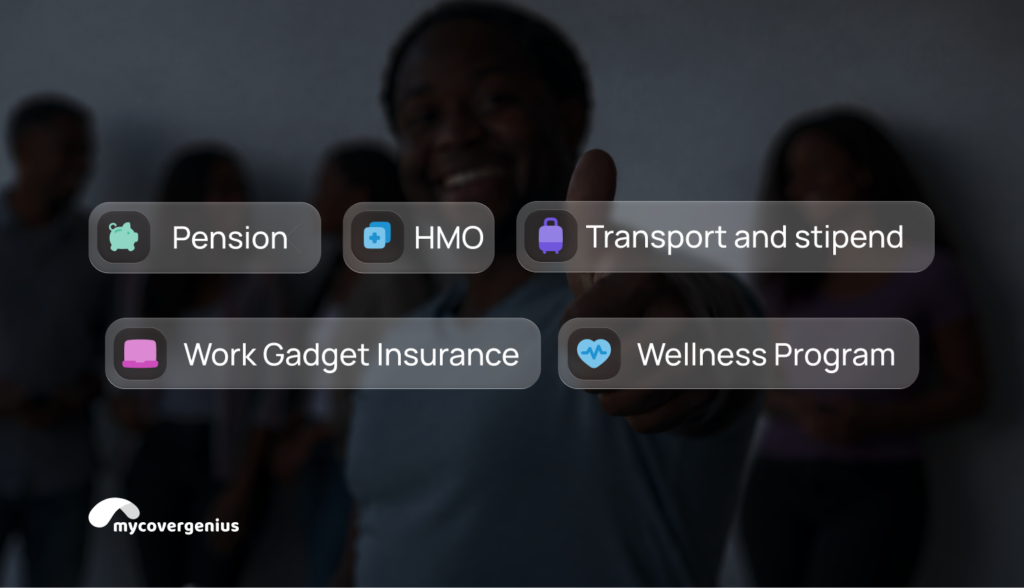
Understanding what your employees truly value is key to allocating your benefits budget effectively. Not all benefits deliver the same return on investment in terms of satisfaction and retention.
What employees value most: ranking employee benefits by impact
- Employee health benefits rank as the most valued benefit among Nigerian employees. Over 85% of employees consider them essential. This makes sense given Nigeria’s healthcare costs: private hospital visits for common ailments cost ₦20,000 to ₦50,000, specialist consultations run ₦30,000 to ₦100,000, and surgery or hospitalisation can reach millions of naira.
- Flexible work arrangements rank second. Even two days of remote work per week dramatically improves work-life balance. According to The Nigerian Workplace report by Intelpoint, three in ten Nigerian workers spend between 10% and 20% of their income on transportation monthly, while 14.46% spend as much as 30%. Flexible work directly addresses this significant expense.
- Learning and development opportunities also rank high, especially for employees under 35. The chance to gain new skills signals that you are investing in their future. Employees who receive regular training are more likely to stay with their employer.
- Performance bonuses tie compensation directly to impact. When extra effort leads to additional income, employees are more likely to feel recognised and motivated. Unlike fixed benefits, bonuses reward individual contribution and performance. In an economy where 37% of employed Nigerians earn less than ₦100,000 monthly, performance incentives can provide a meaningful income supplement and strengthen retention.
- Wellness programmes have grown in importance post-pandemic. Access to mental health support, gym memberships, and preventive care shows you care about holistic wellbeing. The World Health Organisation reports that every $1 invested in mental health treatment returns $4 in improved health and productivity.
- Some benefits have less impact on retention decisions. Benefits like free office snacks or company-branded merchandise are appreciated but don’t influence long-term satisfaction, particularly for companies with 50 to 200 employees.
The takeaway for you here is that when budgets are tight, prioritise employee health benefits and flexible work policies over smaller perks. Employees remember what protects their family’s health and respects their time outside work.
How to structure your employee benefits package: a step-by-step guide
Moving from benchmarking to action requires a structured approach. If you want your employee benefits packages to deliver real retention value, each decision should build on the last. Here is how to design a package that works for your organisation in Nigeria:
Step 1: Assess your budget
Start by calculating your total compensation budget. Across industries, employers typically allocate between 15% and 25% of overall compensation to benefits. Technology and financial services companies often sit closer to 20% to 25%, while logistics and retail organisations tend to operate between 15% and 18%.
Prioritise statutory obligations first. Pension contributions, leave entitlements, and mandatory insurance requirements are non-negotiable. Once those are covered, allocate the remaining budget to core benefits such as employee health benefits, allowances, and performance incentives.
Step 2: Survey your employees
Avoid assuming you already know what your team values. You should run an anonymous survey asking employees to rank benefits by importance. Ask where current benefits fall short and what support they wish existed. This step often prevents expensive missteps.
You may discover, for example, that employees would rather improve dependent health cover than keep a monthly team lunch. Leadership assumptions frequently differ from employee priorities.
Step 3: Benchmark against competitors
Use industry data as a starting point, not a conclusion. Your real competition for talent is not every employer. It is organisations of similar size operating in your sector.
If you run a fintech with 80 employees, benchmark against other fintech companies employing 50 to 100 people. Comparing yourself to large traditional banks or multinational corporations rarely produces realistic expectations because the economics are fundamentally different.
Step 4: Start with health insurance
If you are building benefits from scratch or restructuring an existing package, begin with health insurance. Among companies employing 50 to 200 people, it consistently delivers the strongest impact on satisfaction and retention. It is also scalable. You can begin with employee-only coverage and expand dependent support as budgets grow.
Evaluate providers carefully. The best health insurance coverage focuses on hospital network strength, claims turnaround time, customer support, and digital access rather than price alone.
Providers such as MyCoverGenius offer SME-focused Providers such as MyCoverGenius offer SME-focused plans designed for growing companies, with flexible options that extend health coverage to employees’ families where broader support is needed.
Step 5: Communicate clearly
Employees consistently undervalue benefits they do not fully understand. If you are spending ₦70,000 monthly per employee, but staff only recognise the health insurance component, much of the retention impact is lost.
Create a simple benefits guide explaining what is available and how to access each offering. Include the full value of benefits in offer letters so new hires understand their total compensation from day one. Founders also produce annual benefits statements showing the naira value of every benefit received during the year.
Clear communication ensures your investment translates into stronger engagement rather than becoming an invisible expense.
5 employee benefits mistakes Nigerian companies make (and how to avoid them)
Learning from common mistakes saves both time and budget. Across Nigeria, companies with 50 to 200 employees often face the same challenges as they try to balance competitiveness with sustainability.
- Copying multinational benefits packages: Trying to replicate multinational perks on an SME budget often creates unnecessary financial strain. Larger organisations operate with very different margins and cost structures. You can avoid this by focusing on high-impact benefits you can sustain. A strong health insurance plan that properly supports employees and their families delivers more value than attempting to match a very premium perk.
- Choosing the cheapest HMO without checking hospital networks: Selecting health insurance based on price alone frequently backfires. Limited hospital options or slow claims processing quickly frustrate employees. Instead, review hospital network coverage carefully. Confirm reputable facilities near where employees live are included, and ask existing clients about claims turnaround times.
- Offering benefits employees do not want: Some companies invest in perks that look attractive on paper but see little actual use, such as underutilised gyms or subsidised meals employees rarely choose. An effective way to avoid this is to survey employees before introducing new benefits. Decisions based on feedback almost always outperform assumptions.
- Poor communication of benefits value: Employers may spend significantly on benefits without employees recognising the investment. When benefits feel invisible, their impact is lost. The best thing to do here is clearly communicate what is available and how to access it. Include the benefits value in offer letters and consider annual statements showing the total naira value provided.
- Not scaling benefits as the company grows: A package designed for a small team rarely meets expectations once headcount expands. Employee needs evolve alongside the organisation. One way to avoid this is to review benefits annually and adjust coverage, learning support, and wellness offerings as revenue and workforce priorities grow.
Employee benefits by industry: what tech, logistics, FMCG, Architecture, and finance companies prioritise
Benefit priorities vary significantly by sector. Workforce structure, operating risks, and talent competition all influence how employers design employee benefits packages across Nigeria.
Tech and startups (50-200 employees)
Technology companies compete aggressively for skilled talent, so benefits tend to focus on flexibility, wellbeing, and career growth.
Typical priorities include:
- Comprehensive employee health benefits through HMOs, often extending to dependents or family plans.
- Remote work stipends for internet or coworking spaces, typically ₦20,000 to ₦40,000 monthly.
- Strong learning and development budgets supporting certifications, courses, and industry conferences.
- Gadget insurance for high-value laptops and work devices.
- Mental health and wellness support addressing burnout risks common in fast-paced teams.
Logistics and delivery
In logistics, operational risk shapes benefits decisions. Employers prioritise protection and performance incentives for field staff.
Common benefits include:
- Accident insurance beyond statutory coverage often ranges between ₦1,000,000 and ₦5,000,000 per incident.
- Health insurance focused on immediate medical access rather than preventive wellness programmes.
- Performance bonuses are tied to delivery targets or safety records.
- Fuel allowances or vehicle maintenance support where employees use personal vehicles for work.
FMCG and retail
Retail and FMCG employers focus on reliability, attendance, and workforce mobility across multiple locations.
Typical offerings include:
- Health insurance combined with transport allowances to offset commuting costs.
- Shift differentials for weekend, evening, or night work often paying 20% to 50% above base hourly rates.
- Employee product discounts, which also encourage brand familiarity and advocacy among staff.
Financial services (banks, microfinance banks, fintechs)
Financial services companies tend to offer some of the most comprehensive packages within the 50 to 200 employee bracket, driven by regulatory expectations and competition for experienced professionals.
Common priorities include:
- Family-inclusive health insurance and expanded life insurance coverage, often equal to two or three years’ salary.
- Professional development sponsorships supporting certifications such as the Association of Chartered Certified Accountants (ACCA), Institute of Chartered Accountants of Nigeria (ICAN), CFA Institute (CFA), or ACI Financial Markets Association qualifications.
- Housing loan schemes or education support for employees’ children used by some employers as long-term workforce stability tools.
Across industries, the strongest benefits strategies align closely with operational realities rather than copying trends from unrelated sectors.
Architecture and design firms
In Nigerian architecture firms, benefits focus on productivity, career growth, and project delivery. Typical priorities include:
- Employee health benefits, which are sometimes extended to senior staff or project leads.
- Professional development and certification support, including licensing exams and software training.
- Software and digital tool allowances for BIM and design work.
- Flexible or hybrid work when project phases allow.
- Transport or site allowances for staff visiting construction sites.
- Project-based performance bonuses linked to delivery milestones.
These patterns reflect global and local trends in architecture firms, where health coverage and career support are valued more than luxury perks.
Ready to build a competitive employee benefits package for your team?
You now have the benchmarking data and framework to see where your current employee benefits stand and identify gaps. Health insurance remains the foundation of any competitive package.
Talk to MyCoverGenius to explore SME-focused health plans designed for Nigerian companies with 50 to 200 employees and build a benefits package that fits your budget while meeting your team’s needs.
Frequently asked questions about employee benefits in Nigeria
What is a good employee benefits package in Nigeria?
A good employee benefits package includes comprehensive health insurance, pension, 25 to 30 days leave, transport allowances, performance bonuses, learning and development, and flexible work arrangements.
How much should a company budget for employee benefits?
Nigerian companies with 50 to 200 employees should allocate 15% to 25% of total compensation for benefits.
Do small businesses need to offer health insurance?
Yes please. Health insurance is now legally required in Lagos State under the Ilera Eko scheme, and other Nigerian states are expected to follow. Beyond legal compliance, HMO benefits for employees are critical for retention in Nigerian companies.
What are the most important employee benefits for retention?
Comprehensive health insurance, flexible work arrangements, and learning opportunities rank as the top three best employee benefits for retention in Nigeria.
Can my company start small and scale up later?
Yes, Nigerian companies with 50 to 200 employees can start with basic benefits and add enhanced coverage as revenue grows.
How do I choose the right HMO for my employees?
Look for a plan that offers comprehensive coverage, and check whether employees’ families are covered. Evaluate the hospital network, claims processing speed, and digital accessibility, then compare prices to find the best fit for your team.